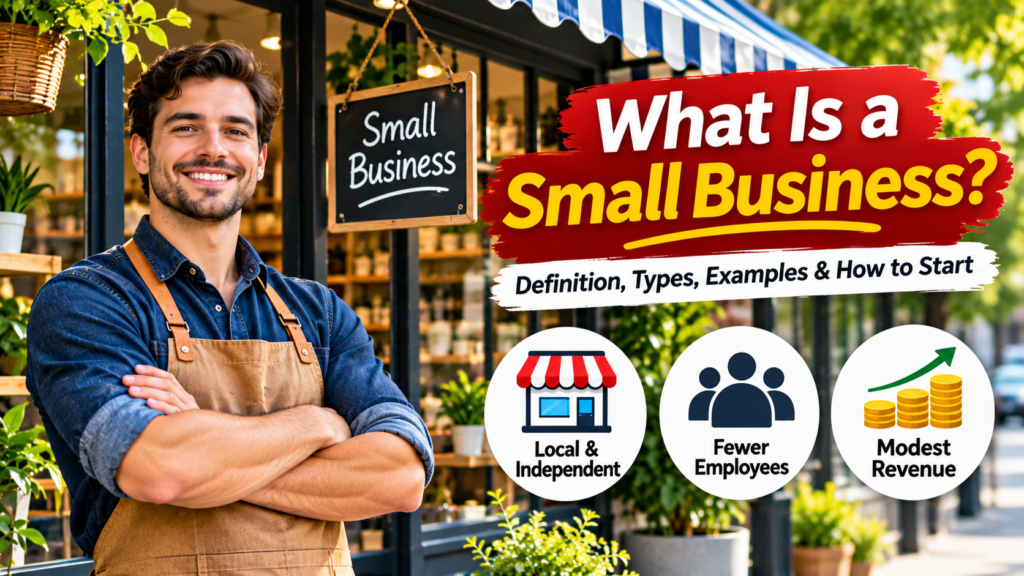
A small business is an independently owned and operated company that generally has fewer employees and lower revenue than larger companies in its industry. It may be a neighborhood grocery store, a family-owned restaurant, a freelance design service, or an online clothing shop. These businesses provide products or services, create employment opportunities, and contribute to local economies. Although they are often associated with small storefronts, some operate nationally and generate millions in annual revenue.
Quick answer: A business does not need a particular storefront, number of employees, or legal structure to be considered small in everyday terms. For official U.S. government programs, classification depends on industry-specific standards established by the Small Business Administration (SBA).
What Qualifies as a Small Business?
There is no universal definition that applies to every industry and country. In the United States, the SBA uses specific criteria to determine whether a company qualifies for certain federal programs.
1.) Number of Employees
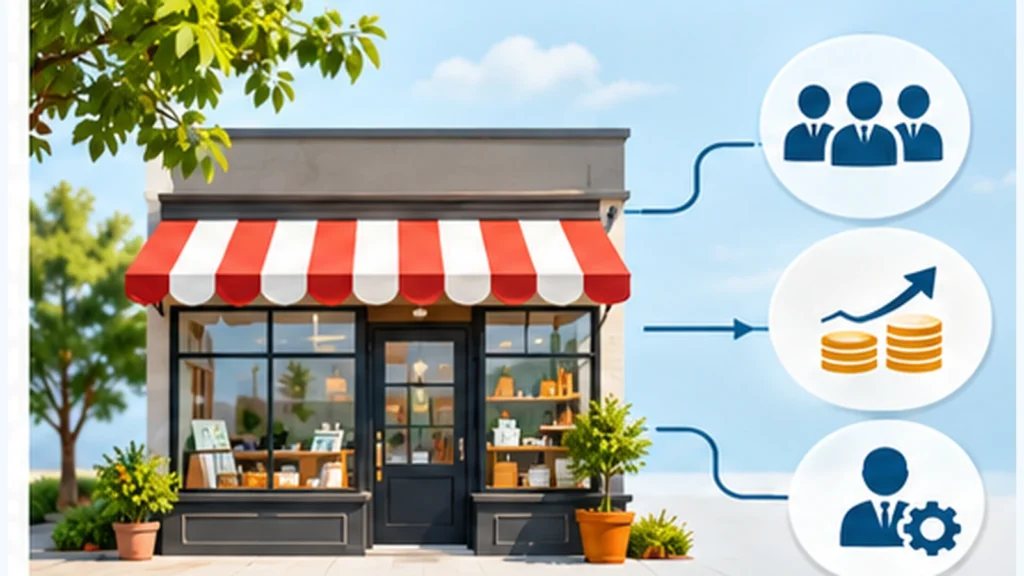
Employee count is an important factor in business classification. A neighborhood coffee shop might employ five people, while a manufacturing company could employ several hundred workers and still qualify under its industry’s applicable SBA standard. For official purposes, the SBA generally calculates employment using average payroll headcounts over a specified period.
2.) Annual Revenue
Some industries are classified using average annual receipts rather than employee numbers. For example, a consulting firm and a manufacturing operation may have different size limits because their operating costs, revenue models, and industry conditions differ. Annual receipts are not the same as profits. A company might generate substantial sales while earning a relatively small profit after expenses.
3.) Independent Ownership and Operation
For SBA contracting purposes, eligible businesses generally must operate independently and must not be nationally dominant in their field. A local store owned by an individual may fit this description, while a store controlled by a large corporation could require additional examination.
4.) Industry Classification
The SBA uses North American Industry Classification System (NAICS) codes to apply size standards across different industries. Manufacturing, construction, retail, agriculture, and professional services do not necessarily share identical requirements. Businesses seeking official classification should check the SBA size standards for their specific industry.
15 Examples of Small Businesses
Small businesses operate in nearly every industry. Some require physical premises and employees, while others can operate entirely online. Here are 15 common examples.
| Business example | What it provides | Typical operating model |
|---|---|---|
| Coffee shop | Coffee, snacks, and beverages | Local storefront |
| Bakery | Bread, cakes, and pastries | Retail or home-based |
| Hair salon | Haircuts and styling | Service-based |
| Auto repair shop | Vehicle maintenance and repairs | Local workshop |
| Cleaning company | Residential or commercial cleaning | Mobile service |
| Freelance writing service | Articles, editing, and copywriting | Online |
| Graphic design studio | Branding and visual design | Online or office |
| Online clothing store | Clothing and accessories | E-commerce |
| Tutoring business | Academic lessons and test preparation | Online or in-person |
| Landscaping company | Lawn care and outdoor maintenance | Local service |
| Photography business | Portraits, events, and commercial photography | Mobile or studio |
| Web development agency | Websites and technical services | Digital service |
| Pet grooming service | Grooming and animal care | Mobile or storefront |
| Bookkeeping service | Financial recordkeeping | Office or remote |
| Independent grocery store | Food and household essentials | Retail storefront |
These examples describe common business models, not automatic proof of eligibility under a particular government program.
Example: A Neighborhood Bakery
Imagine a bakery operated by two family members with three employees. The owners buy ingredients, prepare baked goods, serve customers, and manage daily finances. They make most operational decisions themselves. This is a familiar example of an independently operated local enterprise.
Example: An Online Design Agency
Consider a graphic designer who serves clients remotely and eventually hires two additional designers. Even without a physical storefront, the agency operates as a business by providing services in exchange for payment. An online operation can qualify for relevant classifications just as a traditional physical company can.
Example: A Growing Manufacturing Company
A manufacturing business might employ hundreds of people, operate specialized equipment, and supply products to multiple states. Despite being much larger than a neighborhood shop, it may still fall within the applicable SBA size threshold. This illustrates why business classification should not be based on appearance alone.

Common Types of Small Businesses
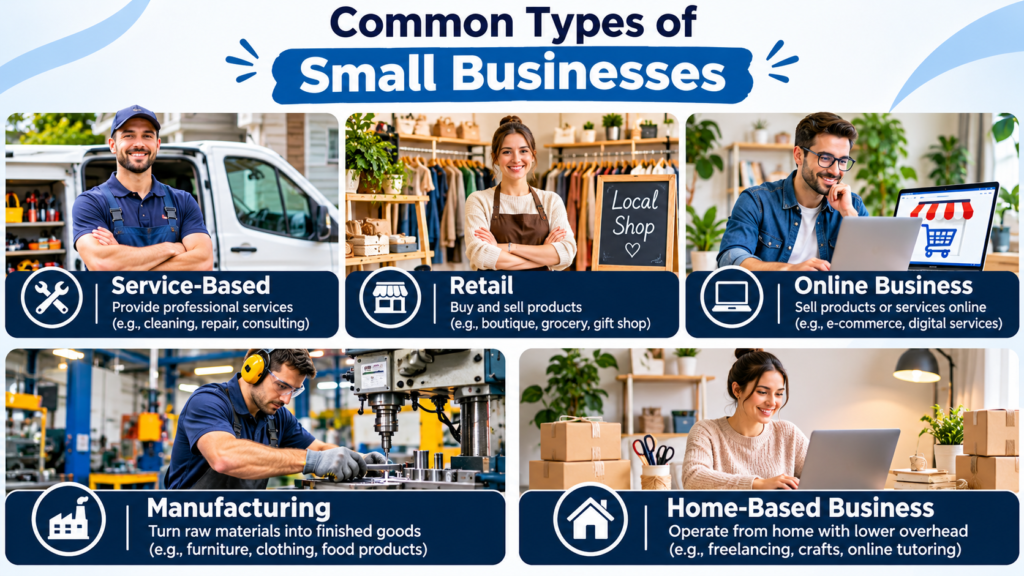
Businesses can be grouped according to how they make money and serve their customers.
1.) Service-Based Businesses
These companies earn money by providing expertise or completing tasks. Examples include cleaning companies, consultants, electricians, accountants, tutors, and digital marketing agencies. Their primary resources often include professional skills, equipment, and time.
2.) Retail Businesses
Retailers purchase or produce goods and sell them directly to consumers. Examples include clothing boutiques, independent bookstores, gift shops, and grocery stores. Retail operators must manage inventory, product pricing, suppliers, and customer demand.
3.) Online Businesses
Digital businesses sell products or services through websites, marketplaces, or other online platforms. Examples include e-commerce shops, online teaching services, website development companies, and subscription-based software providers. Operating online may reduce certain property expenses, but owners still need to manage marketing, customer service, taxes, and technology.
4.) Manufacturing Businesses
Manufacturers convert raw materials or components into finished goods. Examples include furniture makers, small food producers, clothing manufacturers, and specialty equipment companies. These operations may require larger investments in machinery, workspace, employees, and safety procedures.
5.) Home-Based Businesses
Some entrepreneurs operate from their homes rather than renting commercial space. Examples include freelance writing, online tutoring, handmade crafts, and certain administrative services. However, home-based operations may still be subject to zoning rules, licensing requirements, and local regulations.
Key Characteristics of Small Businesses:
Although individual companies differ, several characteristics frequently appear among smaller enterprises.
Independent decision-making: Owners often have substantial control over pricing, hiring, suppliers, and operations.
Direct customer relationships: Customers may interact with the owner or a familiar team rather than a large customer service department.
Limited resources: Smaller firms may have tighter budgets, fewer employees, and less access to financing.
Operational flexibility: A relatively simple management structure can allow quick adjustments to customer feedback.
Owner involvement: Founders may handle multiple responsibilities, including marketing, financial planning, and service delivery.
Not every business will display all these characteristics. A growing company may establish formal departments and professional management while remaining within its industry’s official size standard.
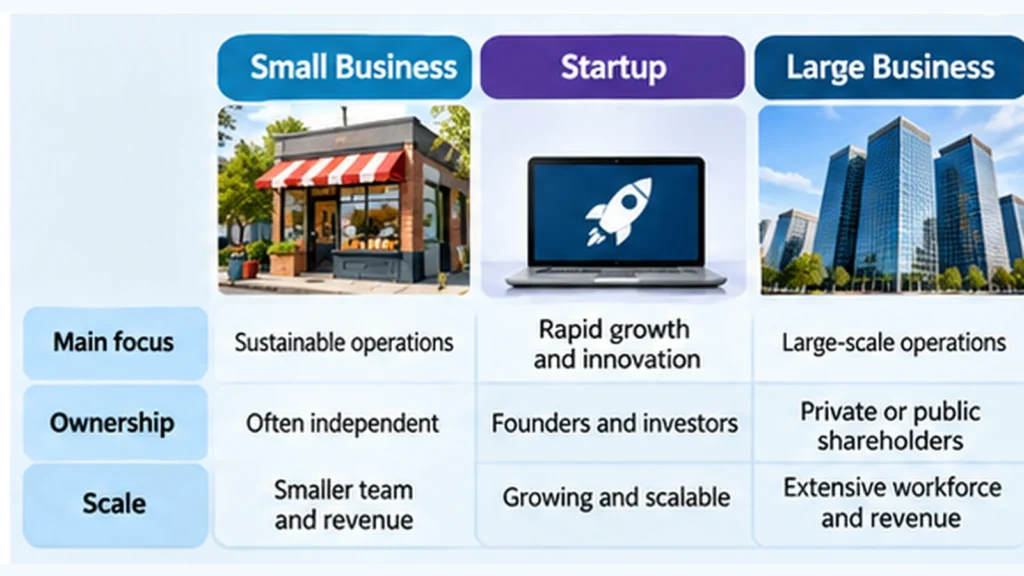
Small Business vs. Startup vs. Large Business
These terms describe related but different concepts.
| Feature | Small business | Startup | Large business |
|---|---|---|---|
| Main concept | Business size | Business development and growth model | Large-scale operations |
| Ownership | Often independent | Founders and possibly investors | Private or public shareholders |
| Growth objective | May favor steady growth | Often pursues rapid, scalable growth | Varies by corporate strategy |
| Operations | Local, regional, or national | Often testing or expanding a model | Frequently extensive |
| Funding | Savings, loans, revenue, or investors | Savings, investors, or revenue | Revenue, debt, or capital markets |
The important distinction: A startup can also be a small business. A company does not automatically stop being a startup when it hires employees, and not every newly opened shop follows a startup-style growth model. For instance, a neighborhood restaurant may focus on stable profitability, while a new software platform may prioritize rapid expansion into multiple markets. Neither approach is inherently better.
Advantages and Disadvantages of Small Businesses
Business ownership offers opportunities, but it also introduces responsibilities and financial risks.
Advantages:
Greater independence: Owners can make decisions about products, operating hours, business direction, and customer relationships.
Closer customer connections: Direct communication can help owners understand customer preferences and improve services.
Flexibility: Smaller teams may adjust services, processes, or marketing strategies without extensive approval structures.
Disadvantages:
Financial uncertainty: Revenue may fluctuate, especially during the early stages.
Limited funding: New or smaller companies may struggle to secure affordable financing.
Heavy workloads: Owners frequently manage several responsibilities at once.
Competition: Established companies may benefit from larger advertising budgets, purchasing power, and established distribution networks.
Cash flow pressure: Even profitable businesses can encounter difficulties when expenses must be paid before customer payments arrive. Understanding these trade-offs helps aspiring entrepreneurs plan more realistically.
Why Are Small Businesses Important to the Economy?
Independent enterprises support employment, provide specialized services, and create commercial opportunities for local communities. According to the U.S. Small Business Administration’s Frequently Asked Questions About Small Business 2026, the United States had approximately:
- 36.2 million small businesses.
- 99.9% of all U.S. businesses classified as small.
- 62.3 million people employed by these businesses.
- 45.9% of private-sector workers employed by smaller firms.
These figures demonstrate their substantial presence in the U.S. economy. Source: SBA Office of Advocacy — Frequently Asked Questions About Small Business 2026. Beyond employment, these companies serve important everyday needs. A neighborhood grocery store provides convenient access to essentials. A local repair company maintains homes and equipment. An independent technology agency supports other organizations with digital services. Smaller enterprises can also introduce new ideas, serve specialized markets, and purchase goods or services from other local companies.
How to Know if Your Business Qualifies as Small
If you already operate a company, use the following checklist to investigate its classification.
| Question | What to check |
|---|---|
| What industry am I in? | Identify your main business activity and NAICS code |
| How many employees do I have? | Calculate employment using the applicable SBA rules |
| What are my annual receipts? | Review the required accounting period and calculation method |
| Is the company independent? | Examine ownership, control, and affiliated businesses |
| Which standard applies? | Compare your details with the correct industry threshold |
Important: The SBA may require you to include employees or receipts from affiliated companies. Meeting a size threshold also does not guarantee approval for loans, contracts, or grants. The official SBA size standards resource is the appropriate starting point for U.S. federal eligibility questions.
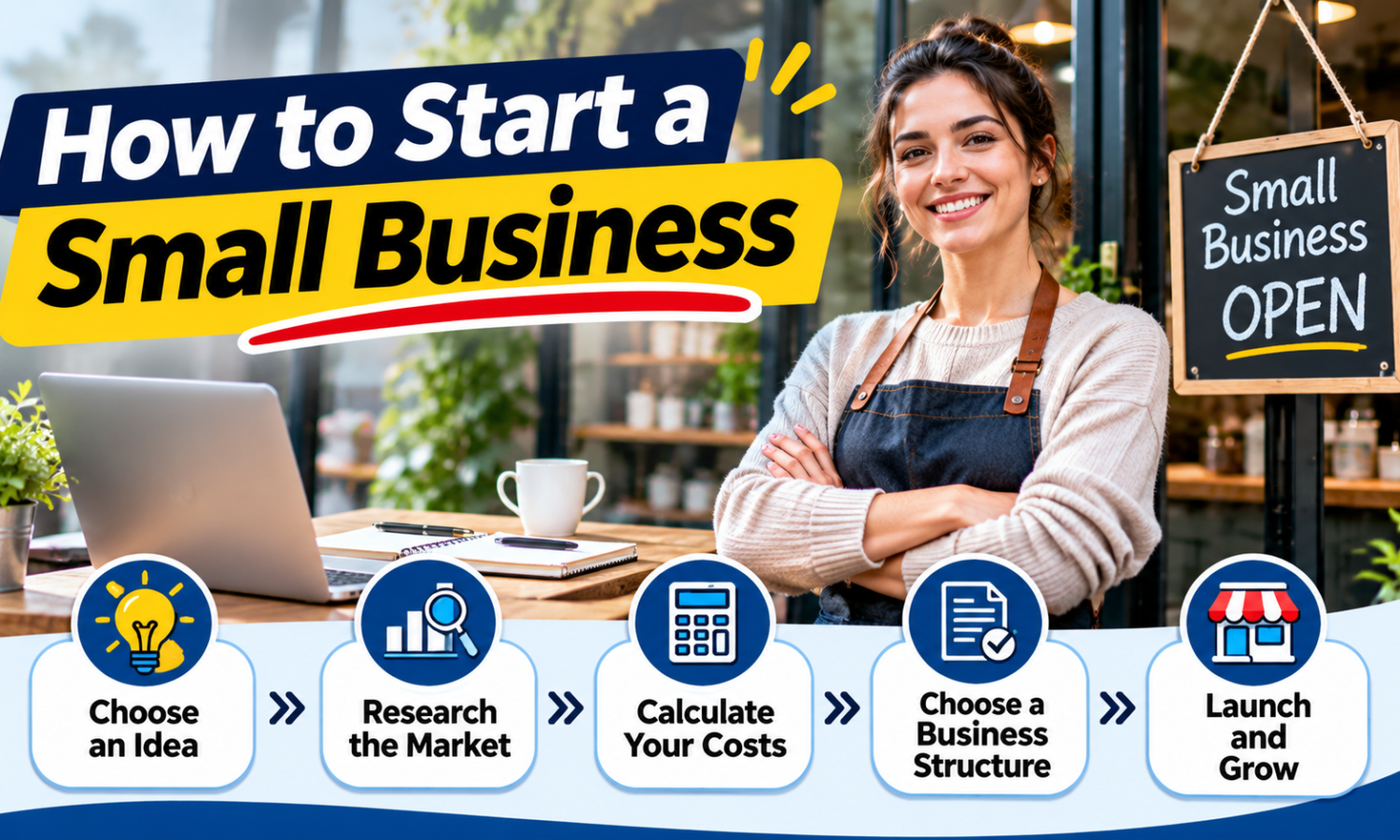
How to Start a Small Business
Understanding business definitions is helpful, but aspiring owners also need a practical way to evaluate an idea.
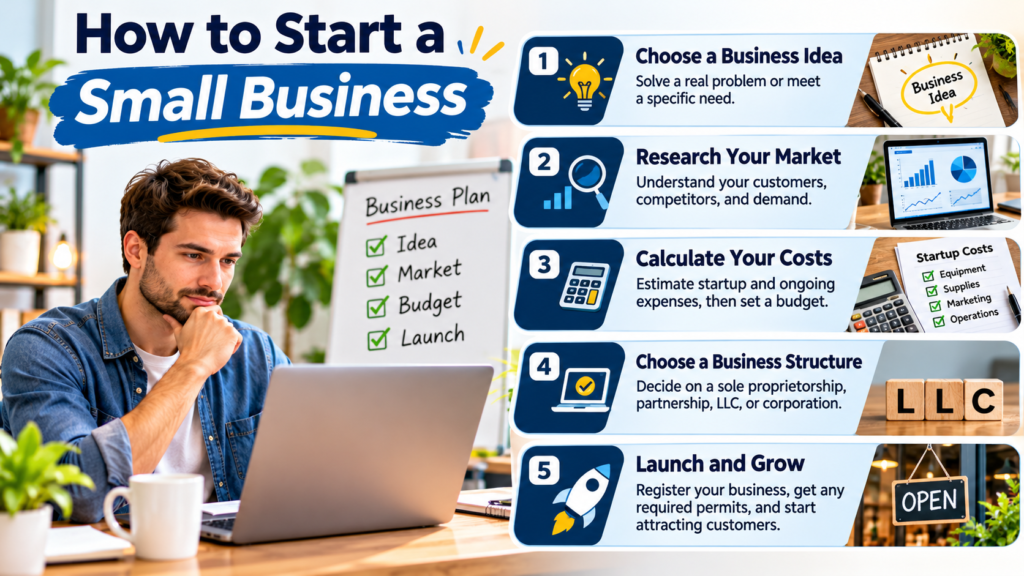
Step 1: Identify a Customer Problem
Start with a product or service that solves a recognizable problem. For example, a residential cleaning service might address the needs of busy homeowners who have limited time for household maintenance.
Step 2: Research Your Market
Identify potential customers, evaluate existing competitors, and estimate demand. Speak with prospective buyers and explore what they already use, what problems remain unsolved, and how much they are willing to pay.
Step 3: Calculate Startup Costs
Estimate your initial expenses, including equipment, inventory, registration, software, insurance, and marketing. Then calculate ongoing expenses to understand how much revenue may be required to cover costs.
Step 4: Choose a Business Structure
Common U.S. legal structures include sole proprietorships, partnerships, limited liability companies (LLCs), and corporations. Each has different implications for liability, taxation, management, and administration. Registration requirements depend on the business’s location and activities.
Step 5: Test Before Expanding
Consider offering a limited service, testing a product with initial customers, or launching a small pilot. Evaluate customer feedback, pricing, demand, and profitability before committing significant additional resources. The SBA business planning guide provides further resources for market research, budgeting, and developing a business plan.
Frequently Asked Questions
1. What is considered a small business in the United States?
In everyday language, it is generally an independently operated company with a comparatively limited workforce or revenue. Official SBA classification depends on the specific industry’s size standard and other eligibility requirements.
2. How many employees can a small business have?
There is no single employee limit for every industry. Some SBA standards allow hundreds or more than a thousand employees, while other classifications use annual receipts instead.
3. Can one person own a small business?
Yes. Freelancers, consultants, independent contractors, and sole proprietors can operate legitimate one-person enterprises.
4. Is an online business considered a small business?
Yes. An online clothing store, digital marketing agency, or web development company can qualify. A physical storefront is not inherently required.
5. What is the difference between a small business and a startup?
Business size and startup status describe different things. A startup typically emphasizes developing and expanding a business model, often with significant growth ambitions, while a smaller enterprise may focus on stable operations and long-term profitability.
6. Do small businesses need to make a certain amount of money?
There is no universal minimum revenue required to be described as a business. Official classification may impose maximum annual receipts thresholds depending on the industry and program.
7. Is an LLC automatically a small business?
No. An LLC is a legal structure, not a size classification. It may qualify as small or large depending on its operations, ownership relationships, and the applicable standards.
8. Can a small business receive government funding?
Some businesses may qualify for government-supported loans, contracting opportunities, or specific assistance programs. Availability and eligibility vary, and classification alone does not guarantee funding.
Final Thoughts
A small business can take many forms, from a one-person consulting practice to a growing company with hundreds of employees. What matters for formal classification is the applicable industry standard, the company’s size, and other eligibility requirements. For aspiring entrepreneurs, understanding these differences is a useful starting point. It helps you explore business models, evaluate opportunities, and plan with realistic expectations. The next step is not necessarily to make a large investment. Start by identifying a customer need, researching demand, estimating costs, and testing whether your idea can deliver sustainable value. A successful business begins with a clear problem to solve, a workable plan, and customers willing to pay for the solution.