
Starting a business doesn’t always mean quitting your job, investing your savings, or working late every night. Many small ventures can begin with skills you already have, a modest budget, and a few dedicated hours each week.
If you’re wondering how to start a side business without sacrificing your steady paycheck, the most practical approach is to begin small, test whether customers will pay, and grow at a pace your schedule can support. You don’t need a perfect idea or an expensive website to begin. You need a specific customer problem, a simple solution, and a realistic plan.
Quick Answer: To launch a side business while employed, review your employer’s rules, identify a skill people will pay for, research potential customers, test a small offer, establish the necessary legal and financial processes, and dedicate consistent weekly hours to finding customers and delivering quality work.
1. Can You Start a Business While Working Full-Time?
Yes. Many people operate businesses while holding regular jobs. However, your employment agreement, workplace policies, business activities, and applicable laws may place restrictions on outside work.
Keeping your job can offer several advantages:
- Financial security: Your regular paycheck helps cover everyday expenses while the business develops.
- Lower financial pressure: You can test ideas before committing substantial money.
- Skill development: Running a business provides experience in sales, marketing, finance, and customer service.
- Flexible growth: You can expand only when demand and available time justify it.
The biggest challenges are limited time, fatigue, and competing responsibilities. A business that requires immediate daytime availability may be a poor fit for someone working a traditional 9-to-5 schedule. Before accepting customers, review your employment contract for outside-work restrictions, confidentiality provisions, intellectual property obligations, and possible conflicts of interest. Use your own equipment and work on your own time.

2. Choose a Side Business That Fits Your Skills and Schedule
The best side business isn’t necessarily the trendiest. It’s one that solves a problem customers are willing to pay to fix and that you can operate consistently.
Start by answering three questions:
- What skills or knowledge do I already have?
- What customer problems can I realistically solve?
- Can I deliver the product or service outside my working hours?
Side Business Ideas for Full-Time Employees
| Business idea | Illustrative startup budget | Flexibility | Best suited for |
|---|---|---|---|
| Freelance writing | $0–$200 | High | Strong writers |
| Virtual assistance | $0–$150 | Medium | Organized professionals |
| Graphic design | $0–$300 | High | Creative professionals |
| Online tutoring | $0–$200 | Medium | Subject specialists |
| Social media management | $0–$250 | Medium | Marketing enthusiasts |
| Digital products | $0–$300 | High | Creators and educators |
| Consulting | $0–$300 | Medium | Experienced professionals |
| Print-on-demand | $50–$300 | High | Designers and online sellers |
These are illustrative planning ranges, not verified market averages. They assume access to basic equipment and exclude potential licensing, insurance, training, and other business-specific costs.
Service-based businesses can be especially appealing because they often let you test demand without purchasing inventory. For example, an employee experienced in bookkeeping might offer monthly recordkeeping services to small businesses. A graphic designer might create fixed-price social media packages.
Use the Five-Factor Business Scorecard
Before selecting an idea, rate it from 1 to 5 in each category.
| Evaluation factor | Question to ask |
|---|---|
| Skills | Can I deliver quality work now? |
| Customer demand | Is there evidence people need this service? |
| Startup cost | Can I afford to test the idea? |
| Time compatibility | Can I operate it outside my job? |
| Repeat business | Could customers buy more than once? |
A higher total suggests a better fit, but the score isn’t proof of profitability. Employment conflicts, legal requirements, and safety concerns must be checked separately.
Practical tip: Start with one clear offer rather than launching several unrelated services.

3. Validate Your Business Idea Before Spending Money
One common startup mistake is investing heavily before discovering whether people actually want the product or service. Business validation means collecting evidence that potential customers have a problem, value your proposed solution, and may be willing to pay for it.
A Simple Three-Step Validation Process
Step 1: Research the market
Find five businesses offering something similar. Review their services, pricing, customer feedback, and target audiences. Look for problems customers mention repeatedly or services that existing providers don’t address well.
Step 2: Speak with potential customers
Ask people who resemble your intended customers about their current challenges.
Useful questions include:
- How are you solving this problem today?
- What frustrates you about your current solution?
- Have you paid for help with this before?
- What matters most when choosing a provider?
Avoid relying entirely on encouragement from friends and family. Positive feedback does not necessarily translate into purchases.
Step 3: Offer a small paid pilot
Create a limited version of your service and see whether someone will purchase it. For example, instead of launching a full-service marketing agency, offer a fixed-price social media audit for one specific type of business. A paid pilot can reveal problems with pricing, delivery time, communication, and customer expectations. Where applicable, complete required licensing or registration before offering paid services.

4. Create a Simple Business Plan and Startup Budget
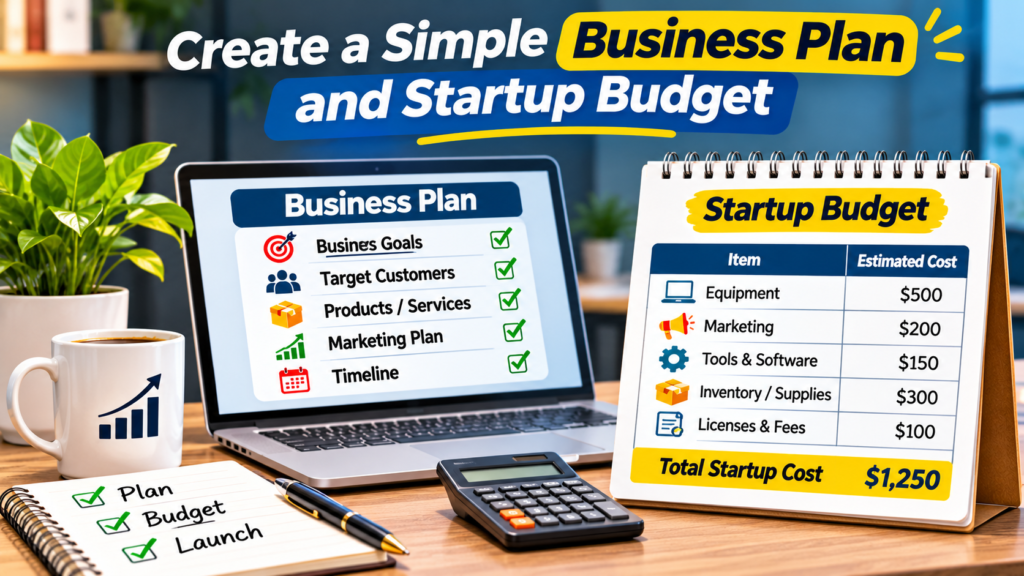
You don’t need a lengthy business plan to begin. A one-page plan is enough to organize the essential decisions.
Include the following:
- Target customer: Who will purchase your product or service?
- Problem: What specific issue are you solving?
- Offer: What will customers receive?
- Pricing: How much will you charge?
- Marketing: Where will you find prospective customers?
- Expenses: What will the business cost to operate?
- First milestone: What result will help you determine whether to continue?
Example: A Small Freelance Service Budget
Imagine starting a freelance content-editing service with equipment you already own.
| Expense | Example amount |
|---|---|
| Domain and simple website setup | $15 |
| Editing or productivity software | $20 |
| Initial marketing and outreach | $30 |
| Illustrative first-month total | $65 |
Suppose two customers each purchase a $200 editing package.
- Gross revenue: $400
- Listed business expenses: $65
- Remaining amount: $335
The $335 is not take-home pay. It excludes applicable taxes, unlisted expenses, and compensation for your time.
This example illustrates how to calculate early results, not what a beginner should expect to earn.
5. Understand Legal, Tax, and Employment Requirements
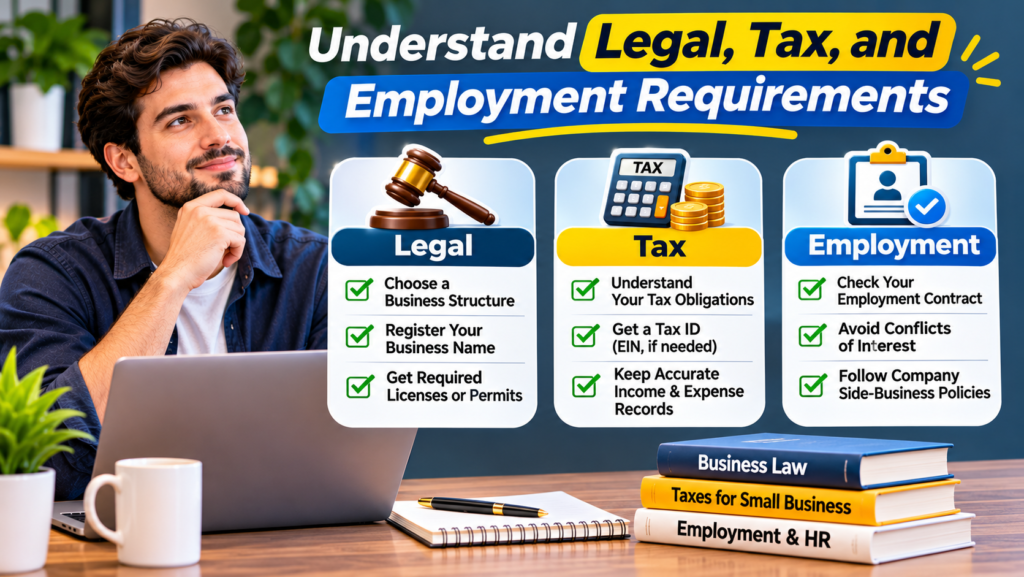
Before officially operating, make sure your business complies with relevant requirements.
Check Your Employment Agreement
Review policies relating to outside employment, client solicitation, confidentiality, conflicts of interest, and ownership of work created during employment.
Restrictions and their enforceability vary. Seek qualified legal advice if your situation is uncertain.
Choose an Appropriate Business Structure
Depending on your location and activities, you may operate as a sole proprietor or establish a separate legal entity, such as a limited liability company. An LLC is not mandatory for every small business. The right structure depends on liability exposure, tax considerations, administrative costs, and state law.
Check Licensing and Registration
Some activities require professional licenses, permits, local registrations, or insurance. Requirements depend on what you do and where you operate.
Keep Accurate Financial Records
Track customer payments, expenses, invoices, receipts, and business-related transactions. Estimated tax payments may be necessary depending on your expected total tax liability and withholding. They are not automatically required solely because business income exceeds $400. Separating business and personal finances makes recordkeeping easier. Consult a qualified professional for advice tailored to your circumstances.
6. Build a Weekly Schedule Around Your Full-Time Job
Your available time is an important business resource. Without a workable schedule, even a promising idea may become exhausting. Rather than committing every evening, identify specific work periods you can maintain over several months.
Example: A 7.5-Hour Weekly Business Schedule
| Day | Business activity | Time |
|---|---|---|
| Monday | Research and planning | 1 hour |
| Tuesday | Marketing and outreach | 1 hour |
| Wednesday | Rest | — |
| Thursday | Customer communication | 1 hour |
| Friday | Rest | — |
| Saturday | Service delivery or product development | 3 hours |
| Sunday | Administration and weekly review | 1.5 hours |
| Total | 7.5 hours |
This schedule is illustrative. Adjust it to your work shifts, household responsibilities, health, and available energy.
Prioritize High-Impact Activities
Early-stage business owners often spend too much time choosing logos, customizing websites, or testing productivity software.

Focus first on activities that directly support a viable business:
- Understanding customer problems.
- Improving your offer.
- Contacting potential buyers.
- Delivering paid work.
- Tracking revenue, costs, and customer feedback.
Automate repetitive tasks when the benefits justify the expense, but don’t purchase multiple subscriptions before you have customers.
7. Find Your First Paying Customers
You don’t need a large social media following to make your first sale. Start with a narrow customer group and a clear explanation of how you help.
Begin With Your Existing Network
Tell relevant personal contacts, former colleagues, or professional acquaintances what you’re offering, while respecting employer confidentiality and solicitation policies. You can also participate in relevant online communities where people discuss problems your business solves.
Create a Simple Portfolio
Show potential customers what you can deliver.
Your portfolio might include:
- Two or three original work samples.
- A clear description of your service.
- A sample deliverable.
- Transparent pricing or a request-for-quote process.
- A straightforward way to contact you.
If you haven’t worked with paying customers yet, label demonstration projects as samples. Never invent testimonials or past results.
Use Personalized Outreach
A short, relevant message is more useful than a generic sales pitch.
Example outreach message:
Hi [Name], I noticed your business regularly shares updates on social media. I help small businesses prepare consistent, ready-to-publish content packages. If this is an area you’re looking to improve, I’d be happy to share a few ideas and explain how my service works. Avoid mass unsolicited messages. Respect applicable marketing rules and community policies.
Improve Your Offer Through Feedback
After completing a project, ask what worked, what could be improved, and whether the customer would consider purchasing again. A repeat customer can be more informative than a single positive review because it demonstrates continued interest in your offer.
8. Follow a 30-Day Side Business Launch Plan
A 30-day plan makes the startup process easier to manage without assuming you’ll become profitable in one month.
| Week | Main objective | Actions |
|---|---|---|
| Week 1 | Choose an idea | Evaluate skills, review employment rules, research competitors |
| Week 2 | Validate demand | Speak with potential customers, develop a small offer, test pricing |
| Week 3 | Prepare to operate | Complete required setup, create samples, organize finances |
| Week 4 | Start selling | Contact prospects, offer a pilot where appropriate, collect feedback |
Week 1: Build Your Foundation
Choose one business idea and describe the customer problem it solves in a single sentence. Research competing businesses and estimate your startup costs.
Milestone: A defined business concept and target audience.
Week 2: Test Your Assumptions
Have meaningful conversations with potential customers. Identify the most important requirements and refine your offer.
Milestone: Evidence about customer needs and potential willingness to pay.
Week 3: Prepare Your Business
Complete necessary legal or administrative steps. Prepare your portfolio, pricing, service terms, and payment process.
Milestone: A clear offer that can be delivered responsibly.
Week 4: Begin Customer Outreach
Approach relevant prospects, respond to questions, and offer your service. If you secure a customer, focus on quality and clear expectations. If you don’t, review the feedback and adjust your approach.
Milestone: A completed initial outreach cycle and a better understanding of demand.
Remember that your first month is primarily about learning and reducing uncertainty, not guaranteeing revenue.

9. Avoid Common Mistakes When Starting a Side Business
Spending Too Much Before Your First Sale
Avoid expensive equipment, unnecessary subscriptions, and large inventory purchases until you have a convincing reason to invest.
Offering Too Many Services
A narrow offer is easier to explain, price, market, and deliver within limited hours.
Underpricing Your Work
Include research, meetings, revisions, administration, transaction fees, and other indirect work when setting your rates. For example, a $250 project requiring five hours and $20 in direct expenses produces $46 per hour before taxes and additional overhead. Whether that rate is worthwhile depends on your circumstances.
Neglecting Your Full-Time Job
Use personal devices, personal accounts, and nonworking hours for business activities. Protect confidential employer information and meet your employment responsibilities.
Ignoring Personal Well-Being
Persistent sleep loss, missed commitments, and declining job performance are signs your schedule may need adjustment. Schedule recovery time and limit how much customer work you accept.
Assuming Revenue Means Profit
A business can generate substantial sales while earning very little after expenses. Review actual profit and cash flow instead of judging success by revenue alone.
10. Know When You’re Ready to Grow
You don’t need to quit your job to operate a successful business. Some people prefer maintaining both sources of income indefinitely. If you eventually want to transition into full-time entrepreneurship, assess the business objectively.
Consider whether:
- Customers are purchasing consistently.
- Revenue and profit are stable across multiple months.
- You understand your operating costs and tax obligations.
- You have appropriate personal financial reserves.
- Demand exceeds what you can reasonably deliver part-time.
- You have a plan for health coverage, benefits, and income fluctuations.
Before expanding, consider raising prices when justified, improving your processes, narrowing your service offerings, or outsourcing clearly defined tasks.
Leaving a job should be a carefully evaluated financial and personal decision rather than a reaction to one successful month.

Frequently Asked Questions
Can I start a business while working for another company?
Often, yes. However, employment agreements and workplace policies may restrict certain outside activities. Review your obligations and avoid conflicts involving clients, confidential information, or employer resources.
What is the easiest side business to start?
A service based on an existing skill may be one of the simplest options because it can require limited equipment or inventory. Freelance writing, tutoring, design, and virtual assistance are examples, but ease depends on your experience and market demand.
Can I start a side business with $100?
Some service-based businesses may be testable with $100 or less if you already own the necessary equipment. Confirm any additional registration, licensing, insurance, and operating costs before setting your budget.
How many hours a week should I dedicate to my business?
For some employees, five to ten hours per week can be a manageable starting point. Choose a schedule that allows you to maintain your job performance, personal responsibilities, and health.
Do I need an LLC for a side business?
Not necessarily. Some businesses begin as sole proprietorships. Whether an LLC is appropriate depends on liability concerns, taxes, state requirements, and the nature of your activities.
How long does it take for a side business to become profitable?
There is no universal timeline. Profitability depends on demand, pricing, expenses, business model, and your ability to acquire customers. Track financial results rather than relying on promised income timelines.
Do I have to pay taxes on side business income?
Potentially, yes. US business income generally needs to be considered for tax reporting, and self-employment tax and estimated tax obligations depend on the applicable rules and your overall financial situation.
Should I quit my job when my side business starts making money?
Not based on early sales alone. Evaluate sustained net profit, customer retention, personal savings, benefits, and financial obligations before considering a full-time transition.
Final Thoughts
Learning how to start a side business is less about having a revolutionary idea and more about consistently solving a problem customers value. You can begin with skills you already have, test an affordable offer, and build a schedule around your existing responsibilities. Your first goal shouldn’t be to replace your salary immediately. It should be to establish whether the business is useful, financially viable, and sustainable.
Start with one idea, one defined customer problem, and one small action this week. Build on the evidence you gather, and let genuine customer demand guide your next steps.